As emerging software engineers, it is natural to worry whether AI can replace us in programming work. For new software developers just starting out, whether they are currently studying, choosing the right degree, or considering a career in software development, this question can feel very real. AI tools can now write functions, debug code, explain code and even create simple prototypes in minutes or hours instead of days or weeks. This can cause concern among beginners about whether they will be replaced by a computer program. So, will AI replace programmers?
The answer to this question is simple: no, not in a direct sense.
Repetitive, predictable and pattern-based tasks can already be assisted by AI tools today very easily. The larger spectrum of work of a programmer, however, involves making judgment calls, solving hard problems, designing systems, making decisions based on context and taking responsibility for complex software.
The greatest concern for new programmers is that they may learn programming at a very superficial level, only by writing lots of code. That kind of work can become easier to automate. But for a developer, AI should be another tool to use. They still need to understand the problem, debug the code, evaluate the output, and translate messy or vague requirements into working software.
Why AI Feels Like a Real Threat to Beginners
It’s normal to be worried about new technology. Right now, there is already a lot of work that junior developers can do faster by using the right AI tools. For example, AI tools can generate code, explain other people’s code, suggest bug fixes, generate test code and even help with code reviews.
So, the question “Will AI replace programmers?” feels very relevant now, and it is not just something to discuss for the future.
However, using AI for these tasks is still different from understanding the full problem and choosing for how the software works for real users.
What AI Can Already Handle in Coding
Here’s a look at where AI can currently add value and help beginner coders work faster on routine coding tasks.
Generating boilerplate code
Suggesting code while you type
Explaining unfamiliar code
Writing simple tests and documentation
Spotting likely bugs
Helping with routine refactors
Giving first-pass feedback in code review workflows
Much of the code written in software development can be routine in nature or follow a known pattern. AI-powered tools can help write, explain, comment on and test such code faster. Because of this, new coders may be expected to use these tools to save time while completing routine coding work.
There may be more focus on technical understanding, problem-solving and decision-making, and less time spent on routine coding tasks.
What AI Still Cannot Replace in Programming
These emerging tools are meant to supplement human programmers, not substitute them. Even the companies building these tools describe them that way. GitHub , for example, says Copilot code review should be used as a tool to support human review, not replace it. It also cautions that developers should verify AI-generated feedback carefully.
AI yet cannot handle many parts of programming that require human judgment, context and understanding. Examples include:
Understanding business goals when requirements are unclear or keeps changing
Deciding the application architecture so it remains reliable and scalable over time
Balancing speed, maintainability and security while building software
Debugging unusual failures that appear in real-world usage
Noticing when the requirement itself is flawed
Reviewing AI-generated code for critical functions where money, health, privacy or safety is involved
Programmer vs Software Developer: Why the Difference Matters
To answer this question, one has to differentiate between routine programming on one hand and broader software development on the other hand.
As described earlier, a programmer may spend more time on routine coding, whereas a software developer or software engineer is usually engaged in the broader work of software engineering. Requirements gathering, design decisions, deciding what to implement and what not to implement, testing, maintainability and working with cross-functional teams are all part of broader software engineering work.
While AI is capable of following repeatable steps within the software development workflow to write code for given requirements, it does not do as well with broader engineering aspects where software has to be designed to meet the needs of particular users. Students who want to understand this difference in the broader software engineering context can read this guide on will AI replace software engineers .
Rather than asking whether a typical programmer will be replaced by AI, it is more productive to consider what kind of programmer becomes valuable as more programming work is being assisted by AI.
How AI Changes the Beginner Learning Path
A beginner today should learn how to:
Read and assess AI-generated code properly
Ask clear technical questions
Check whether the suggested answer is correct
Understand why a solution works
Debug when the output fails
Compare two possible solutions
Explain code to another person
Build projects that solve real problems
If a student uses an AI tool to get code for a project and then accepts it without understanding through it or learning from it, then that student is not learning much. However, the student can use AI to test ideas, compare different ways to implement the same solution and learn faster than they would if they were trying to figure everything out on their own.
Skills That Matter More in the AI Era
Important skills include:
Debugging code
Understanding data structures, logic, and systems
Breaking larger problems into smaller parts
Asking better technical questions
Checking whether an AI-generated answer is actually correct or not
Building projects that solve real problems
Understanding how software behaves beyond the ideal case
It is also important how one goes about learning to code. A strong beginner-friendly learning pathway is even more important today, as it can help beginners build strong fundamentals and then use AI in a deeper manner. Scaler School of Technology’s Computer Science & AI Programme is designed with an AI-integrated learning approach where you learn by building 50+ real-world projects.
How the Value of Learning Programming Is Changing
A student who in the past mainly learned how to write code now also needs to learn how systems work, how to solve problems in detail, how to evaluate output from AI tools, and how to develop software that is used by real people in real situations.
As AI tools improve at writing code, new developers who focus only on basic syntax may feel more pressure. But the value of learning how to program properly will not decrease.
If you are unsure whether Computer Science is the right major for you, you can also check out this guide on should I pursue CSE with AI coming up .
People will still benefit from learning how to program properly, tackle problems in an organised manner, check AI-generated code for bugs, and understand how software behaves in real-life scenarios with real users and real systems.
How Programmers Can Work With AI Instead of Competing With It
Working with AI rather than competing with it is the best practical approach. Yes, there is a lot of talk about how fast AI can produce the initial version of a program. But unless someone is only writing a large amount of very simple code, it is difficult to compete with AI only on speed.
The smarter way to work with AI is to treat it as an assistant, while the human developer remains in charge and makes the final judgments.
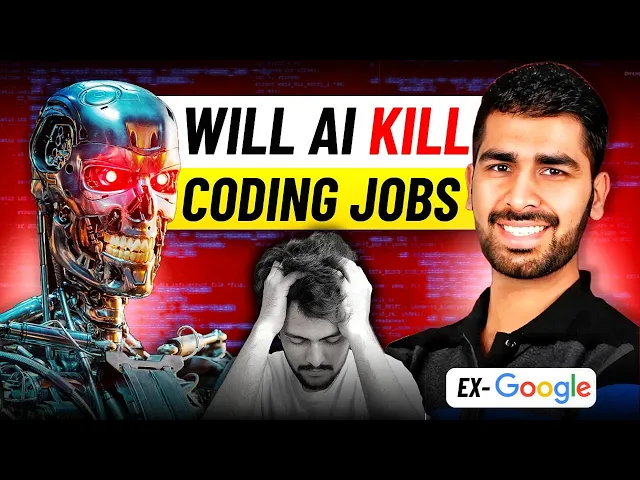
New programmers who are curious about the changes in coding jobs due to the AI revolution might find this video helpful.
Will Artificial Intelligence Kill Coding JOBs || What JOBs will be in Demand?
AI systems can generate the initial version of a function or test case, but the rest of the development still needs human review. This includes checking the logic, adding edge cases, improving function and class names, looking for possible security issues and, in the end, merging the AI-generated code properly into the rest of the system.
Conclusion
AI in programming does not mean that in a few years, all programmers will be unemployed. There is a new challenge for new programmers and even for experienced programmers: what will they need to learn in order to use AI as an integrated part of their workflow?
Strong fundamentals in programming will become even more valuable as AI becomes integrated into coding tasks. So instead of avoiding programming because of AI, beginners should start learning it and go deeper.
In the future, strong fundamentals, problem-solving skills, debugging, systems thinking, project experience and the ability to be productive with AI will matter more.
FAQs
Will AI replace programmers?
No, not completely. AI can automate many repetitive coding tasks, but most programming work still requires human judgment. A human is also required for tasks such as debugging, designing architecture for a given problem, checking security issues and taking responsibility for the software.
When will AI replace programmers?
Currently, there is no fixed point in time predicted when AI will replace programmers completely. AI can automatically complete a large portion of repetitive programming work, but programming is not only repetitive work. A programmer is also expected to debug systems, design systems, understand security implications, and most importantly, take responsibility for what their program does. So, there is still plenty of room for human review and human judgment.
Should beginners still learn programming in the AI era?
Yes, but beginners should focus on the fundamentals of programming, debugging, problem-solving, systems thinking and completing projects. Just because AI can quickly produce code does not mean that no one has to know how it was put together.
What programming skills are harder for AI to replace?
Many aspects of a programmer’s work are deeply rooted in human judgment, specific context and responsibility. There are a few areas where AI is less likely to replace human effort, including debugging a huge codebase, understanding unclear requirements, designing future-ready architecture for other developers, testing edge cases, reviewing AI-generated code and making technical trade-offs. They all require a complete understanding of the problem at hand and cannot be solved by just writing code.