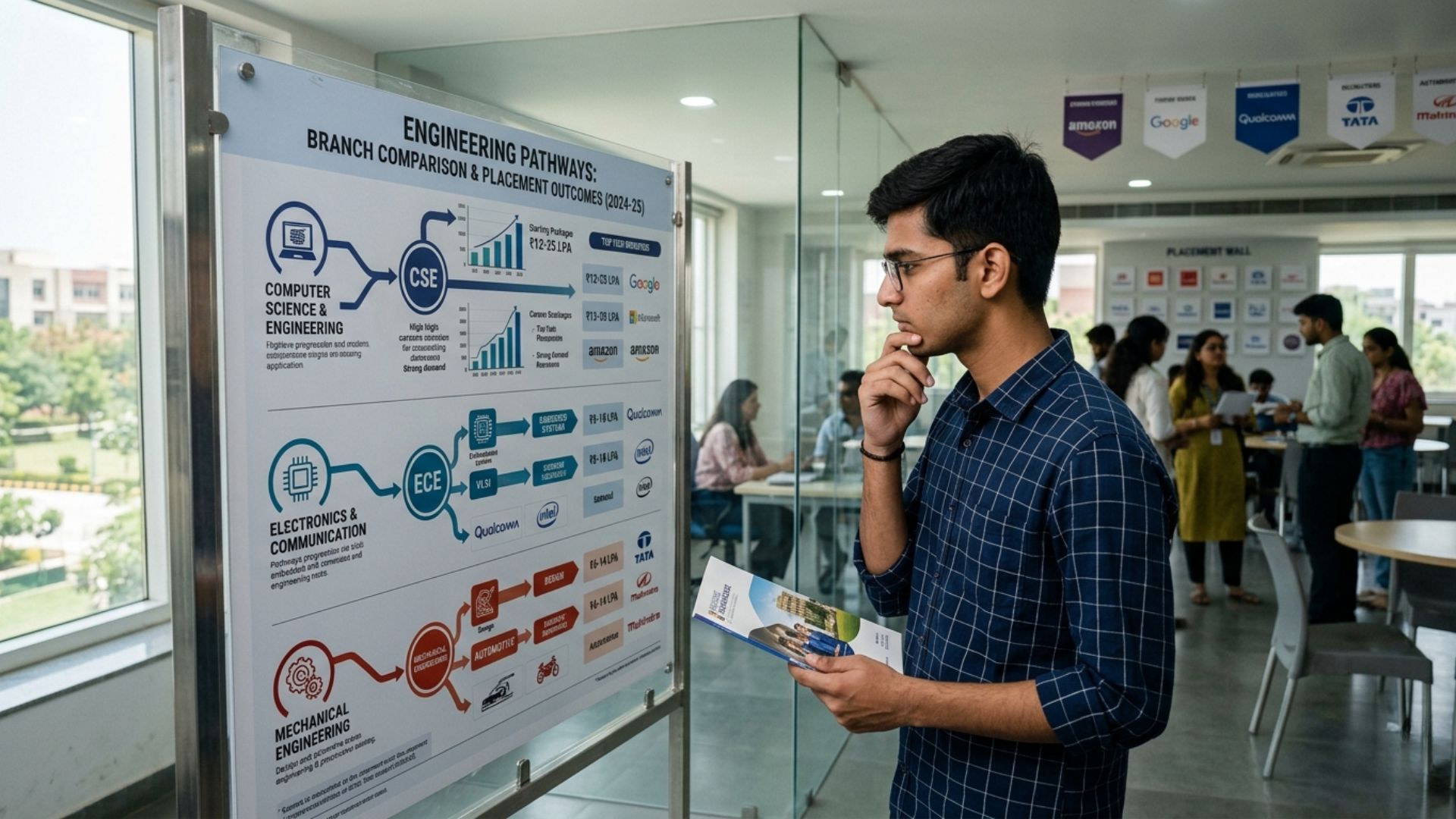
Which engineering branch actually gives students the best placement outcome: CSE, IT, AI/ML, Data Science, or ECE? That sounds like a simple question, but the answer is rarely as direct as students expect. While CSE often leads overall, placements also depend on the college, the recruiter mix, the roles offered, and how the numbers are being compared.
So while CSE usually leads overall, students should look at both the branch and the college before treating it as the automatic best choice.
Why placement numbers can be misleading
Placement numbers are often shared as simple highlights, but they do not always tell the full story.
A high placement rate can be viewed as a good one, but it does not reflect the kind of roles or salaries students actually received. On the other hand, a high average package can be influenced by a few strong offers and may not reflect what most students get. The highest package is even more limited, as it usually represents one or two exceptional cases.
To understand placements better, it helps to look at multiple indicators together:
Placement rate: How many students got placed
Median salary: What a typical student earns
Average salary: The overall average across offers
Highest package: The top offer, not the common outcome
Another factor students usually overlook is the type of companies and roles. Two branches in the same college may show similar placement numbers, but the roles offered, job profiles, and growth opportunities can be very different.
So when students ask which branch has highest placement, it is better to look beyond one number and understand the full picture
Which engineering branches usually perform strongly in placements?
Some branches that often perform strongly are:
Computer Science Engineering (CSE)
In many colleges, CSE is closely associated with strong placement outcomes because it opens up a wide range of software, product, data, and computing-related roles.
Information Technology (IT)
IT is often very close to CSE in placement opportunities, especially in colleges where the curriculum and recruiter pool overlap. In many campuses, IT students are considered for similar software roles.
AI/ML and Data Science
These branches attract attention because of growing demand in AI, data, machine learning and analytics-related work. Their placement strength often depends on how well the program builds core computing skills along with specialisation.
Electronics and Communication Engineering (ECE)
ECE remains one of the stronger branches in many good colleges. It can offer flexibility across electronics, embedded systems, telecom, and in some cases software-related roles as well.
Core branches such as Mechanical, Electrical, Civil, and Chemical
These branches can also lead to solid careers, but placement outcomes are usually more role-specific and more dependent on the college, industry exposure, and the student’s own direction.
Students should not choose a branch only by placement trends. Interest, learning fit, and long-term career direction matter just as much.
Why the college matters as much as the branch
The same branch can lead to very different placement outcomes depending on the college.
A CSE seat in one college may come with stronger recruiters, better internship access, more serious peer competition, and a learning environment that pushes students to build real skills. In another college, the same branch may exist on paper, but the exposure, training, and placement support may be very different.
This is also why some students look beyond just the branch label and pay closer attention to the kind of undergraduate environment they are entering. At Scaler School of Technology, the focus is on strong computer science foundations, practical projects, industry immersion, and career outcomes.
That is why the branch should never be judged in isolation. Placement outcomes are shaped by the college’s overall ecosystem, the companies that visit, the quality of training, the peer group, and the kind of academic and practical exposure students get over four years.
A student usually makes a better decision when they think about both things together: the branch they want and the kind of college/institution they are likely to join.
What shapes placement outcomes beyond the branch
Placement outcomes are also shaped by:
The quality of the college/institution
How relevant and practical the curriculum is
Internships and industry exposure
Coding, communication, and interview preparation
Projects and hands-on learning experiences
Peer group and learning culture
The strength of the placement ecosystem
Two students from the same branch can still end up with very different outcomes. What they build during college matters a lot.
A branch should not be chosen only for placements
Placements matter, and it makes sense for students to think about them while choosing a branch. But placements alone should not be the only factor in making the choice.
A branch can appear strong due to its popularity, recruiter-friendliness, or be linked with better salary outcomes. Even then, it does not imply that it is necessarily the correct fit for all students. If a student has no real interest in the subjects, struggles to stay engaged, or cannot imagine working in that area for years, the branch can become difficult to sustain.
A better choice usually balances both sides: career outcomes and personal fitment. Students tend to do better when they pick a branch they can genuinely learn well in, stay consistent with, and grow in over time.
For most students, a better decision is not just about choosing what is currently in demand. It is about choosing a branch that matches their interest, strengths, and long-term career direction.
Common mistakes students make
Students often make a few avoidable mistakes while thinking about branch-wise placements:
Assuming one branch performs best in every college
Confusing the highest package with the strongest overall placements
Choosing a branch only because it is trending
Ignoring the role of college quality
Assuming the branch alone is enough without skill-building
Overlooking other strong options like IT or ECE
Placement trends can be useful, but they should be considered with context.
Conclusion
If students are asking which branch has highest placement, CSE is usually the strongest overall answer. That is why it comes up again and again in student discussions and ranking-style articles. But branch alone does not decide the result. College quality, recruiter mix, practical training, and the student’s own skills matter just as much.
So the better way to think about it is simple: do not choose a branch only because it feels like the safest option. Choose a path where the branch, the college, and the learning journey all work together. That is what usually leads to better placements in the real world.
FAQs
1. Which branch has the highest placements?
For students wondering which branch has highest placement, Computer Science Engineering (CSE) is often seen as the strongest answer in many colleges. It usually attracts a wide range of recruiters and opens up roles in software, product, data, and related tech fields. That said, placement strength can still vary from one college to another.
2. Is CSE the only branch with good placements?
No. Information Technology, AI/ML, Data Science, ECE are also branches which do well in most colleges. The difference often depends on the college, the recruiter mix, and the kind of roles offered on campus. That is why students should not assume one fixed ranking applies everywhere.
3. Should students choose a branch only for placements?
Not always. Placements matter, but they are only one part of the decision. A better branch choice usually takes into account interest, learning fit, long-term career direction, and the kind of college a student is joining. A branch tends to work out better when the student can stay engaged with it over time.