When you are looking for a college where you can prepare for software, AI, product or data careers, getting a CSE seat in a good engineering college is not enough. What is most important is finding a college that can help you acquire the necessary technical skills for relevant jobs after graduation.
Don’t go only by the image that college rankings or brochures portray, because they may not show the full picture. When you are looking for a college for software, AI, product or data careers, what matters most is the strength of the CSE program that the college offers.
Why a Private College List Is Not Enough
A list of private engineering colleges in Bangalore can help students get started with their search for the right engineering college in Bangalore. It can also help them know which colleges are generally considered for engineering admission and which of them offer courses like CSE or other engineering streams.
Most college websites and brochures contain similar information. They often talk about lab sessions, industry exposure, placements, innovative projects and infrastructure. But what matters most to a student interested in a computer science-oriented education is the actual Computer Science experience on campus.
Thus, even two colleges offering CSE programmes can have very different student experiences. There can be a lot of variation in how engineering colleges deliver the learning experience to students. One college may be project-driven, where students get to do in-depth coding as part of their project work and prepare for joining the technology industry after completing their degree. Another college may offer a more classroom-based experience, with a stronger focus on building the fundamentals of the student.
Check Admission Routes, Fees and Basic College Details
Students should first verify the admission routes, fees, scholarships, hostel fees and counselling process of the respective private engineering colleges in Bangalore before comparing them only in terms of CSE reputation.
Many colleges follow different modes of admission like KCET, COMEDK UGET, NSET , JEE Main, etc. Many colleges also follow institution-level admission processes. Fees, scholarships, hostel fees and the counselling process can vary from college to college.
Students should also verify college approvals, accreditations and affiliations. This can give them an idea about the college structure, curriculum flexibility, evaluation process and overall academic environment.
Evaluate the Technical Strength of the CSE Programme
At its core, a strong tech career is based upon a strong technical foundation that a CSE programme helps develop. So, it is natural for students to investigate the technical seriousness of a CSE programme.
A good CSE programme should have good depth in the core subjects of Computer Science, even while incorporating tools and latest trends in the field. These include:
Programming
Data structures
Algorithms
Operating systems
Databases
Computer networks
Software engineering
These are not mere course content, but subjects that shape the way a student thinks, solves problems and adapts to the latest tools in their career after four years.
Moreover, in order to judge the technical strength of a CSE programme, students must also consider the amount of practical implementation that the programme emphasises. Stronger CSE programmes focus on helping students think, solve problems, grow technically and implement what they have learned through various means
Regular programming assignments
Practice through lab work
Strong project work
Meaningful electives
Learning about modern technological concepts such as AI, Machine Learning, Cybersecurity or Data Science, while not diluting the fundamentals of Computer Science
In an age where newer specialisations are being heavily promoted by many programmes, it is important that students focus on a strong core of Computer Science Engineering. Only then can a degree translate into strong long-term value for the student.
Students who are comparing CSE-focused options in Bangalore can read this guide on the best computer science colleges in Bangalore.
One should also consider newer options like Scaler School of Technology, which offers the CS & AI Programme in Bangalore. The programme is positioned around Computer Science Engineering for the AI era, with AI integrated from the start and a learn-by-building approach.
Scaler School of Technology has been featured by Daily Jagran in its list of top institutes and AI courses for aspiring tech professionals in 2026.
Compare Fees With Career and Learning Value
Fees of various colleges should not be compared in isolation from the career and learning value it can give. In simple words, students can consider higher-fee colleges if they provide quality CSE education, practical exposure, sufficient internships, good coding culture on campus and a good learning environment. Such a college can be compared with other colleges offering CSE at lower fees but not providing enough learning and career opportunities.
A lower-fee college option could also be good if the college can deliver strong fundamentals, reliable opportunities for practice and good practical exposure.
Students should not compare colleges only on the basis of fees. What is important is what they are getting in return, such as good learning, exposure and career outcomes.
The fees of the same branch in private engineering colleges in Bangalore can vary greatly.
Check the Practical Learning Environment for CSE
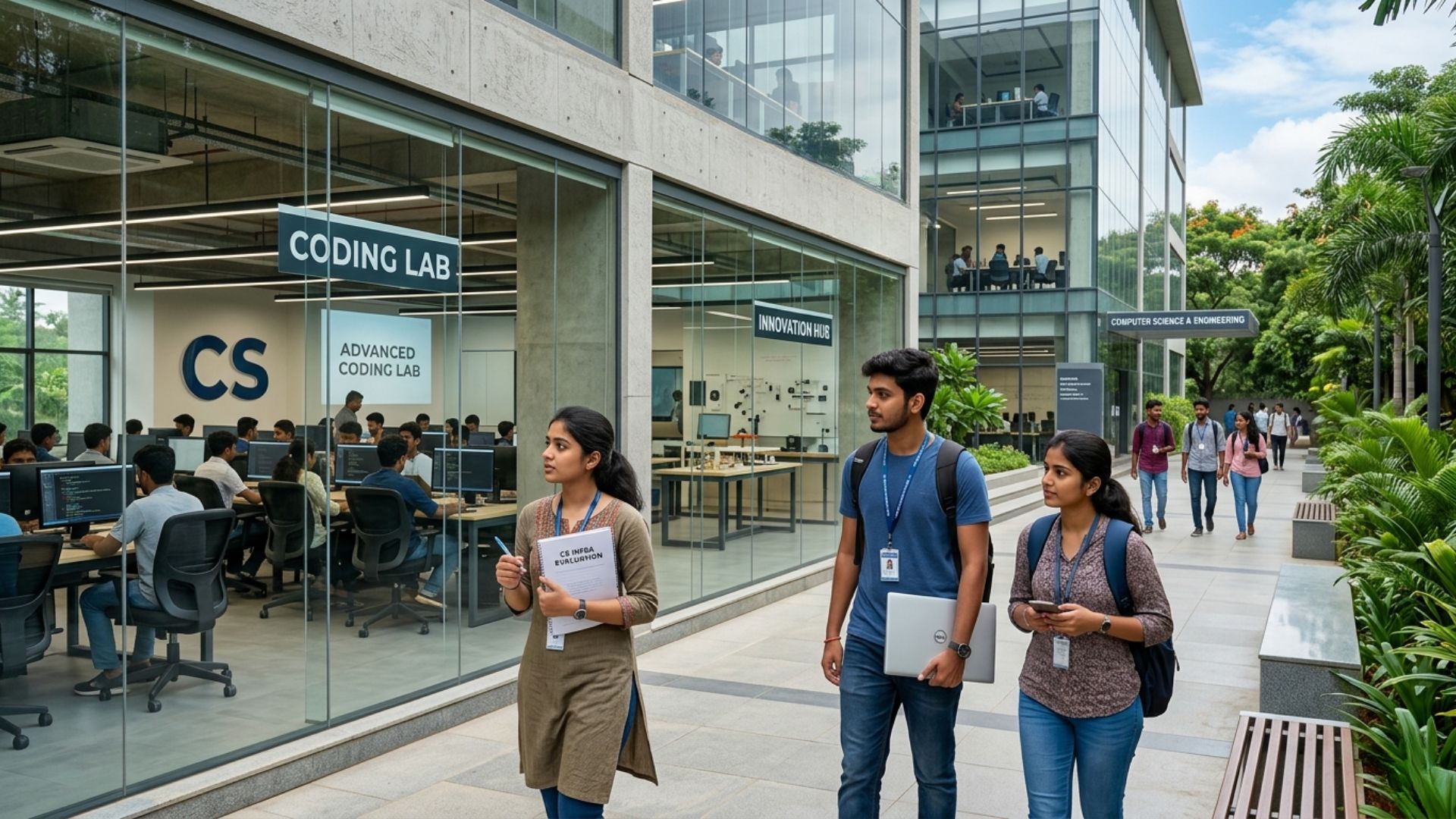
What the CSE college teaches should go beyond classroom experiences and help students get skilled through coding, projects, tech clubs and practical work outside regular lectures.
That usually becomes visible in activities such as:
Active coding clubs
Hackathons and coding contests
Project presentations
Peers who take coding and internships seriously
Labs that are actually useful for hands-on work
Faculty support beyond classroom teaching
Workshops, technical events and student-led communities
A good programmer or technical professional continuously practices to improve their skills. Students studying in good CSE colleges are usually engaged in activities like building, experimenting, failing, fixing and improving while studying Computer Science. Just learning in class and completing assignments before exams is not sufficient. One needs to practise consistently and work on various projects to get hands-on experience.
Students in Class 12 who are trying to figure out whether Computer Science is the right field for them after 12th can watch this video.
What is Computer Science? Is it worth to study CS after 12th?
Assess Internship and Placement Relevance for Tech Careers
Placements should be seen from a role-quality point of view, not just from a salary point of view.
Students should check:
Whether the college attracts software and product roles
Do internship opportunities exist?
Are there chances for the students to gain experience in the field of development, testing, data, AI, cybersecurity or others?
Whether opportunities are spread across a wider part of the batch
Whether the college shows good technical outcomes over time or not
The highest package does not necessarily mean the college is the best for CSE students. Better indicators are role relevance, internship opportunities, technical exposure and consistent outcomes across the batch.
Students who want to evaluate this further can refer to this guide on computer science colleges with placements.
Verify the College Through Students, Alumni and Visible Outcomes
Evaluating colleges also means checking where current students and alumni are headed.
Verify some of the reality behind it by checking the following:
LinkedIn profiles of current students and alumni
GitHub activity or project portfolios, where available
Student club pages
Hackathon participation
Technical events and project showcases
The kinds of companies and roles alumni get placed into
It is also valuable to get in touch with current students or recent alumni. You might ask:
How active is the coding culture on campus?
Are projects taken seriously?
How useful are the lab sessions and classes for practical work?
Do students get real internship opportunities?
What kinds of jobs do CSE students move into after graduation?
Do students feel prepared for technical interviews?
Talking to current students or recent alumni can reveal details that college admission counsellors may not always share during counselling sessions.
Signs Students Should Be Cautious About
Heavy college branding with little to no student technical work to show for it
Placement claims without enough detail on roles
Weak coding culture on campus
Limited visibility around projects, hackathons or technical communities
Lack of clear information about internships, placements and student outcomes
Each of these alone may not be a reason to reject a college, but if several of them appear together, students should investigate further before making a choice.
Conclusion
This blog guide provides essential tips for selecting the right private engineering college in Bangalore for CSE careers and technology-related careers after graduation. As students go through the admission process, they should not look only at the process or the brand name of the college. Most importantly, the college should provide students with the required skills, experience and confidence to enter the tech workforce.
The key points for a student to consider while looking at private engineering colleges in Bangalore for CSE and tech careers would be the quality of the CSE programme, admission route, fees, campus coding culture, internship opportunities, placement statistics, graduate outcomes and the overall technical environment of the college.
FAQs
Do private engineering colleges in Bangalore provide internships?
Private Engineering Colleges in Bangalore do offer Internships either directly or support interns, but the quality varies greatly from college to college. Students should check whether the opportunities are relevant to CSE roles, when students can expect to start getting internships, and whether most of the batch gets access to internships or only a select few.
How can students contact students of private engineering colleges in Bangalore?
Some of the mediums to contact current students of private engineering colleges in Bangalore are LinkedIn profiles of current students, alumni pages of the college, student clubs, hackathons, coding groups on GitHub and college events. Students can also look for webinars, open houses or public student communities where current students are active.
How can students reach out to private engineering colleges in Bangalore?
Students can reach out to private engineering colleges Bangalore through the official admissions page of the college, enquiry form, email, phone number, webinars, campus visits, open houses or counselling sessions. Make a list of questions you want to ask, such as questions related to the CSE curriculum, admission process, fees, internship opportunities, placement support and the quality of roles students are placed in. Later, go through the list and ask these questions to the people at the college, usually the admissions team.
What should students check before choosing a private engineering college in Bangalore?
Before choosing a college for a technical degree such as engineering, students looking at private engineering colleges in Bangalore should check the CSE curriculum, admission requirements, fees, approval or affiliation details, coding culture, quality of internships, quality of placement roles, alumni base and hands-on learning experience at the college.