When searching for colleges that offer AI programmes, you will see that many colleges list CSE (AI), AI & ML, AI & Data Science, etc. as separate “branches” of engineering. But is Artificial Intelligence, a separate engineering discipline, or simply a specialisation within Computer Science?
There is a lot of confusion around AI, especially because it has found its way into many different fields. Future of Jobs Report 2025 says that 86% of employers expect AI and information-processing technologies to change the way they do business by 2030. This shift in industry is a big part of why colleges are now offering AI as a separate area of study.
Is AI a Branch of Engineering?
AI is not a core engineering discipline like Civil Engineering, Mechanical Engineering, Electrical Engineering, etc.
Easy way to understand it:
Core engineering disciplines or branches are broad disciplines such as Civil Engineering, Mechanical Engineering, Electrical Engineering, etc. They have a broad set of foundational subjects and can lead to a variety of career paths.
AI is primarily a focused area of work that sits mainly as a specialisation within Computer Science. As a result, there is a large mathematics component and a strong focus on data.
When an institute lists “AI” as a separate department or branch, it can usually mean:
A Computer Science programme which includes more focus on AI/ML-related topics in the coursework.
A CSE programme that allows students to study AI as a stream or track rather than just having a few core or optional courses on AI.
A named AI or AI & ML engineering programme that is built around a Computer Science, data, mathematics and machine learning core.
That is why students see labels such as:
CSE (AI & ML)
CSE (AI)
AI & Data Science
Artificial Intelligence and Machine Learning
What Does AI Branch in Engineering Mean?
AI/AI-ML focused tracks were introduced in CSE programmes in various colleges for a number of practical reasons.
Demand Is Visible
Students will benefit from learning skills that are useful in the industry with the aim of creating AI-based systems. As AI becomes a significant part of products and services, businesses look for people who can work with AI.
More Focused Curriculum
A Computer Science Engineering (CSE) programme might introduce students to AI/ML towards the end of the course through elective subjects. On the other hand, some CSE tracks focus more on AI from the beginning and provide students with a well-defined study path.
Clear Direction for Interested Students
The main advantage for students is that it allows them to choose programmes where an AI-heavy path is the main focus. For students who are already interested in AI, this gives a clearer direction while choosing a programme.
The name of a programme is not enough to make a decision. Another important criterion when choosing a programme is whether it has an industry-aligned curriculum in Computer Science or not.
AI Branch, CSE, IT, and Data Science: What Usually Changes?
Many students fear that by not taking AI, they are missing out on something. As mentioned earlier, there is a lot of common ground between AI, CSE, IT and Data Science. What varies is the extra emphasis on a particular area.
Students comparing these options can read this guide on is data science better than CS .
Software development fundamentals
Most courses advertised with AI, CSE, IT, or Data Science in the name will contain some of the following:
Programming basics
Data Structures and Algorithms
Databases
Basic computer systems
Logical thinking and debugging
Software development fundamentals
What Usually Changes in AI/AI-ML Tracks
Typically, core Computer Science and Mathematics subjects are studied in greater depth by programmes carrying the AI label.
Probability, statistics, and linear algebra
Machine learning
Model training and evaluation
Data handling and experimentation
Computer vision or NLP through projects or electives
What You Study in an AI Engineering Track
There are several learning blocks in an AI Engineering Track.
1. Computing and Engineering Fundamentals
Even most AI programmes still develop a foundation in:
Programming and problem-solving
Data structures and algorithms
Databases and data handling
Computer systems basics
Software engineering
Building complete projects
A programme which attempts to address AI tools from the outset may leave students without enough support to use them well later on.
2. Maths Used in AI
The maths used in AI includes:
Linear algebra
Probability
Statistics
Calculus and optimisation basics
It does not mean you have to like maths, but you should be able to learn it and apply it by the time the programme has ended.
3. Machine Learning Fundamentals
This is the core AI layer. Here are some of the things students usually learn when going through an AI programme:
Supervised and unsupervised learning
Training and testing models
Overfitting and underfitting
Evaluation metrics
Improving model performance
4. Deep Learning Basics
Neural networks
How learning happens inside models
Basic deep learning concepts
Computer vision or NLP through electives or projects
5. Data and System Awareness
Collecting and cleaning data
Working with data pipelines
Creating local, small-scale systems based on models
Knowing what models do within an app
Considering speed, errors, reliability, and monitoring
6. Projects Where AI Becomes Practical
By working on a real project, students put their knowledge of AI into practice to develop a working solution that can be tested.
A model + small app on top of it
A prediction tool
A computer vision or NLP-based project
An outcome that can be measured, even if it is small
Who Should Choose AI as a Branch?
AI is typically the right choice for you if you:
Love maths, patterns, and logical reasoning
Like testing things out and iterating on the results
Like the idea of designing intelligent systems
Are okay with continuous learning
Love programming and solving problems
CSE might appeal to you more if you:
Want to have a strong background in software, computer systems, and computer science
Are not completely sure about AI and would like more options down the road
Want to design products and applications
Want the option of choosing different kinds of jobs first before specialising
ECE/EE might be right for you if you:
Like hardware, electronic circuits, and applied maths
Like systems that are a combination of devices and computation
Want to design sensors, robots, or communication systems
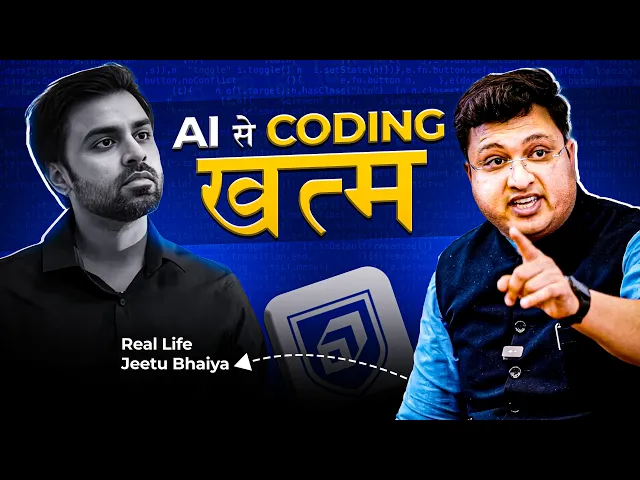
To understand this learning path better, students can also watch this video.
Advice for CSE & AI Aspirants from Real-Life Jeetu Bhaiya - Nitin Vijay Sir(Founder of Motion) :
A Tech-Focused CS & AI Programme
If you’re interested in a well-rounded CS education with deep AI knowledge as part of the curriculum, then you might be interested in the CS & AI programme at Scaler School of Technology (do follow) - which follows a learn-by-building approach by building 50+ projects.
The programme is built around:
Project-led learning
AI introduced early in the curriculum
Expert instructors from top tech companies like Google, Meta, Amazon, etc
A focused residential learning environment
Student clubs and peer learning
Access to the Scaler Innovation Lab - India’s Deep Tech Lab
The selection process comprises eligibility verification, online application, NSET / eligible fast-track shortlisting, multiple rounds of interviews, and the final admission decision.
The Times of India featured Scaler School of Technology and its applied CS & AI-centric education model in an article. In particular, it focuses on the product-building-centric curriculum, applied AI systems, industry-led learning, hands-on project experience in real technology, and more.
Conclusion
Artificial Intelligence, or AI, is an engineering pathway that uses Computer Science as its base. At many institutes, AI is treated as a separate specialisation within the field of CS. There are many institutions around the world that treat AI as a separate engineering discipline and offer it as a separate degree. But the main point is the curriculum for the AI degree: how much maths, coding, machine learning, data, project work, etc. it includes.
From the point of view of maths, logic, experimentation and project work, AI can be a really good option. But AI isn’t for everyone, and for those interested in a broader Computer Science base with scope to specialise after a while, CSE may be more suitable.
If you are still unsure between should I choose AI or Computer Science , then it’s good to think about the amount of coding, maths, data, projects, etc. you can sustain in the long run and then compare this with your current interests and future career goals.
FAQs
Do I need to be very strong in maths for AI?
AI engineering requires a reasonable grasp of maths and the ability to put it into practice; however, it is not necessary to be the best at maths, and it is definitely possible to become good at AI engineering.
Can I do AI if I take CSE?
There are many students who have taken CSE as their major and have moved into AI/ML by taking relevant AI/ML electives, doing projects, internships and certifications in AI/ML, and applying what they have learnt to real-life scenarios.