
Engineering entrance exams after 12th is an important topic for students, as their plans for pursuing engineering often become more serious. JEE is one of the most prominent engineering entrance exams after 12th science. While many students also prepare for other undergraduate entrance exams, including state-level, private university and consortium exams, specialised undergraduate programmes may have their own entrance exams as well.
This will help students understand majority of entrance exams after 12th for engineering. It is not necessary for a student to attempt every entrance exam. There are various routes for engineering admission and different entrance exams for undergraduate courses and colleges. Therefore, students should understand the list of entrance exams in detail and select suitable options according to their engineering college goals, branch preference, location, college fees and level of preparation.
Why Students Should Know Their Engineering Entrance Options After 12th
The ways in which a student can get into engineering colleges in India are varied. While many colleges consider the scores obtained in a national-level entrance test, some consider scores from state-level entrance tests. Some private universities in India hold their own entrance tests for admission to engineering colleges within the university.
Knowing the options in advance will help students make an informed decision when selecting the right option for themselves and planning for it in a better manner. It will help students avoid relying on a single result and compare various colleges, locations and branches of study offered by different colleges and universities.
Popular Engineering Entrance Exams Students Consider After 12th
Some of the top engineering entrance exams in India that students research after 12th science are given below.
JEE Main and JEE Advanced are among the most recognised national-level engineering entrance exams after 12th. Students can take JEE Main for admission to participating NITs, IIITs and other institutions by securing the required marks or rank. Eligible candidates who qualify through JEE Main can appear for JEE Advanced for admission to IITs across India.
State-level entrance exams such as MHT CET, KCET, UGCET, WBJEE, AP EAPCET and TG EAPCET are used for admission by several engineering colleges across corresponding states. These exams can be useful for students looking for colleges within a particular state or through a home-state admission route.
Private university entrance exams based largely on PCM subjects. These are conducted by different universities for admission to their engineering programmes and may vary in terms of test pattern, speed and marking scheme. Some examples are BITSAT, VITEEE, SRMJEEE and MET.
NSET is relevant for students exploring Scaler School of Technology’s tech-focused undergraduate programme in Computer Science and AI.
For every engineering entrance exam after 12th science, always check the eligibility, exam dates, pattern, counselling process and fees. Students should decide whether a particular engineering entrance exam is relevant to their goals and connects to colleges they would genuinely consider.
How to Choose the Right Engineering Entrance Exams After 12th
For engineering aspirants, it is more important to choose the right exams than to apply for too many. By choosing the right number of exams to include in the shortlist, students can prepare much better and avoid unnecessary stress.
A practical way to choose is to check these factors:
1.Target Colleges
Start with the colleges you are interested in. If an exam does not lead to colleges you would consider joining, there is no point in including it in your list of exams.
2.Preferred Branch
Some students already have a clear preference for CSE or AI-related courses, while others are more open to fields of study such as electronics, mechanical, civil and others. Therefore, branch preference is important when deciding on the right entrance exams and counselling routes.
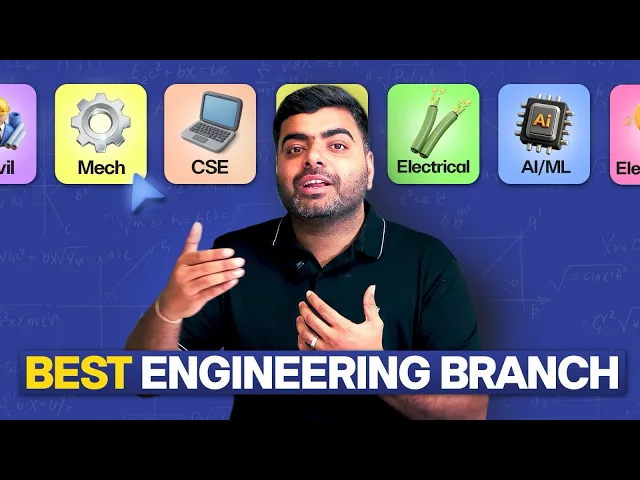
Here’s a video to understand one of the most common mistakes students make while selecting an engineering branch after 12th.
The Engineering Branch Mistake Everyone Makes
3.Location Preference
Some students want to stay close to home, while others are open to moving to another city or state. State-level entrance exams may be more relevant if you are interested in colleges within a particular state.
4.Fees and Scholarships
The tuition and hostel fees of the respective programmes are also important to consider. Some colleges also offer scholarships, which is another factor to take into account when choosing the right exams. The total cost of attending the college for the respective programme should also be considered before finalising a list of exams.
5.Syllabus and Pattern Overlap
Many entrance exams are conducted for students who have studied Physics, Chemistry and Mathematics in higher secondary school. The difficulty level, pace at which questions need to be answered, types of questions and the way marks are awarded may vary from one exam to another.
A good list of exams should not force you to follow a completely different style of preparation every week.
Can Students Prepare for More Than One Engineering Entrance Exam?
Yes, students can prepare for multiple entrance exams for engineering in a practical manner, as most of the exams are based on the same PCM foundation. Therefore, there is no need to start from scratch for every exam.
Typically, the differences lie in:
Exam pattern
Time duration
Question style
Marking scheme
Counselling process
Application timeline
Focus on creating a solid PCM foundation and then work on exam-specific practice in manageable blocks.
A student preparing for a speed-based exam will benefit from timed practice questions. Conversely, a student preparing for an exam with questions asked in a different manner will benefit from mock tests.
How to Manage Boards and Engineering Entrance Preparation
Board exams and entrance exams are connected. The basic subjects for Class 12 board exams, Physics, Chemistry and Mathematics, also form the foundation for various engineering entrance exams.
What needs to be done practically is:
Develop a solid foundation in concepts first
Maintain consistency in board preparation
Use entrance-level practice to improve problem-solving
Do not move to exam-specific mock tests until you have a strong base
Keep track of registration dates and other official updates
Students should not make completely different study plans for different exams because that can be too much to handle. A simple study plan with clear priorities is better.
Common Mistakes Students Should Avoid
Many students make exam preparation more difficult than it needs to be.
Some common mistakes are:
Applying for too many exams without a clear reason
Selecting exams because friends are applying
Disregarding eligibility criteria and counselling rules
Neglecting official dates and deadlines
Assuming all exams have the same pattern as JEE
After the Exam: Think About the Programme, Not Just Admission
Clearing an engineering entrance exam after 12th science is the first hurdle. It is also important to compare the key features of different programmes, including the curriculum, faculty and mentorship, projects, internships and learning environment.
For students interested in technology-focused programmes, there is also the 4-year undergraduate programme in Computer Science & AI offered by Scaler School of Technology. This programme has AI integrated into the curriculum from Day 1 alongside Computer Science fundamentals and focuses on project-based learning and industry exposure.
Your undergraduate programme is more than just getting into college. It is also important to choose the right environment to support your long-term learning, practical skill development and career growth.
Conclusion
Planning for engineering entrance exams after 12th means knowing the various routes available and selecting the most appropriate ones for yourself. Knowing about national-level, state-level, private university-level, consortium-level and specialised entrance exams is the first step. Subsequently, shortlist your options.
A student should look for the appropriate engineering entrance exams after 12th based on factors such as their preferred colleges, course or branch, location, course fees, eligibility criteria and how comfortable they are preparing for a particular entrance exam.
FAQs
Can I prepare for more than one engineering entrance exam together with JEE?
Yes, PCM preparation for JEE can be useful for many other exams. However, there may be differences in the exam pattern, speed of questions, familiarity with mock tests and timing strategy.
Is JEE preparation enough for other engineering entrance exams?
JEE preparation helps in creating a strong foundation in PCM, but it may not be sufficient for some other exams. Students may need to practise pattern-specific mock test papers, increase their speed to complete the paper on time and become familiar with the marking scheme of each exam.
What are the entrance exams for engineering after 12th?
The major engineering entrance exams after 12th include JEE Main and JEE Advanced for eligible students. Other common entrance exams are BITSAT, VITEEE, SRMJEEE, MET and COMEDK UGET. There are also engineering entrance exams conducted at the state level. Examples include MHT CET, KCET/UGCET, WBJEE, AP EAPCET and TG EAPCET. The right options depend on the colleges a student wants to apply to and the states in which those colleges are located.