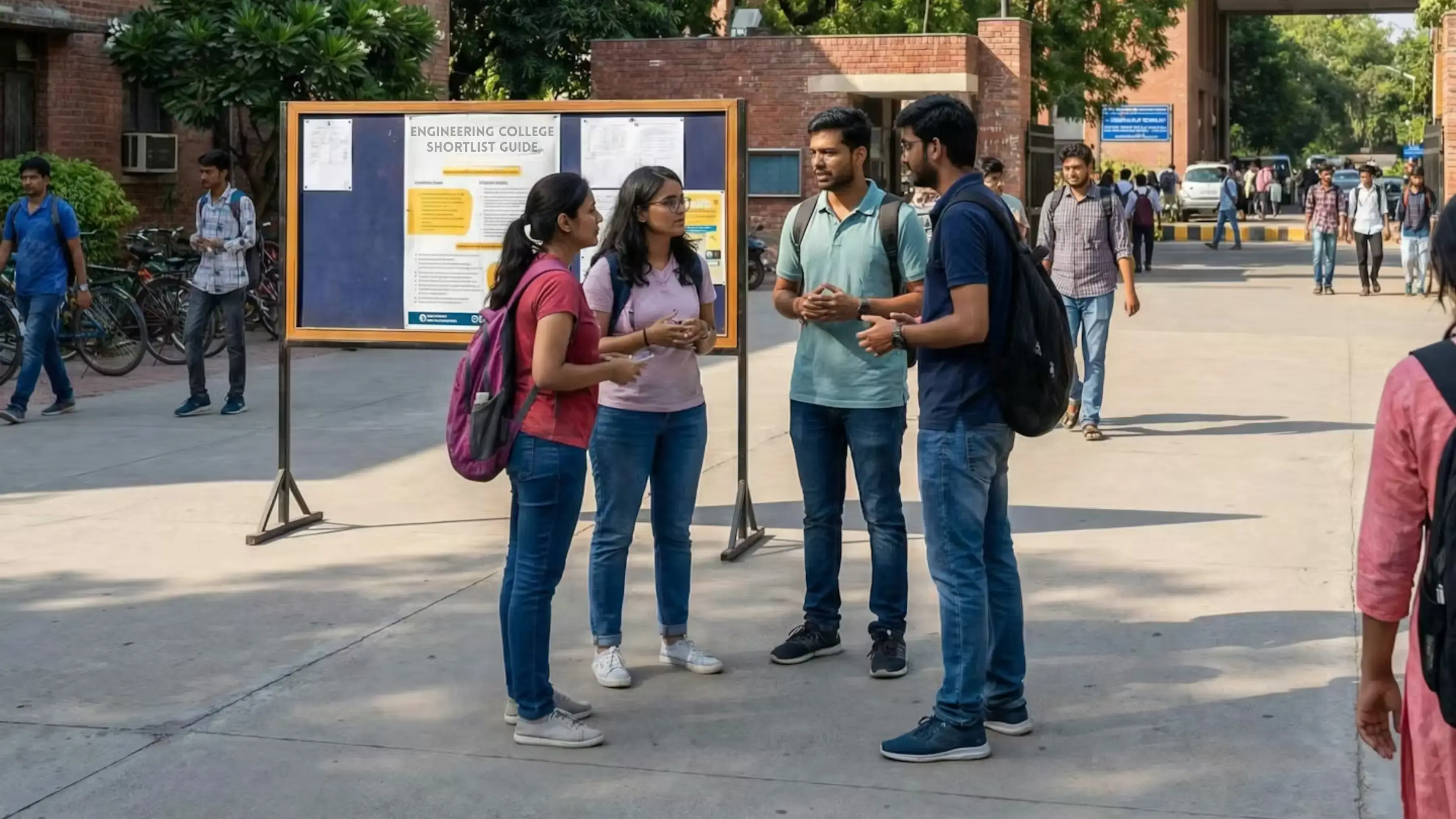
If you’re a JEE aspirant, you’ve probably googled something like “best colleges apart from IIT” at least once. And honestly, it’s a fair question. Most students aren’t choosing between “IIT or nothing.” They’re choosing between multiple good options with real constraints like branch preference, budget, location, and how much risk they want to take with another exam attempt.
This guide is meant to make shortlisting easy and convenient for you. We’ll cover:
What to look at before you shortlist any college
If not IIT what next (the things that actually matter)
How to think about branch selection
A simple method to narrow down a long list into a shortlist you can live with
Before You Shortlist: Define What “good” Means For You
A lot of shortlisting fails because students start with rankings instead of priorities. It helps to set 4–5 filters first and then judge colleges through those filters.
Here are the ones that usually matter most:
Branch fit: Be honest about whether you’re choosing a branch because you like it, or because it sounds “safe.” (More on this below.)
Location + exposure: City vs non-city changes a lot: internships, communities, meetups, part-time work, and even your peer network.
Budget comfort: Fees is not just tuition fee. Add hostel, travel, laptop, and “hidden” living costs and then decide what feels manageable.
Peer group + culture: This is underrated, very underrated. A solid peer group changes how much you build, compete, and improve.
Outcome signals (not promises): “100% placement” banners don’t tell you much. Look for signals you can verify: internships, alumni profiles, active clubs, and project culture, and if you can connect with alumni on LinkedIn and talk to them.
If Not IIT, What Next? Think In Buckets, Not In Lists
To give an idea about the competition, there were 1,80,422 students appearing for JEE (Advanced) 2025, out of which 54,378 qualified [1]. With numbers like that, it’s smarter to think in buckets than chase one “perfect” college list.
1) JEE-route public institutions (non-IIT)
If your JEE Main score is decent, you’ll usually see these in shortlists:
NITs
IIITs
GFTIs (Government Funded Technical Institutes)
These options are structured, counselling-driven, and easier to compare because the route is straightforward and information is relatively visible.
2) Strong state-government colleges (via CET routes)
Many states have strong engineering colleges that don’t require JEE as the primary entrance exam. These aren’t “lesser” colleges just accessed through different exams and counselling systems.
If you’re adding CET routes to your plan, keeping track of dates is half the game. Here’s a quick guide to entrance exams apart from JEE mains (timelines + options)
3) Private Universities
Private colleges aren’t one category. Some have strong peer groups and outcomes, some are expensive and low-output. If you’re considering private options, it’s worth checking:
Do students actually build projects and participate in hackathons/clubs?
Do students get internships by 2nd/3rd year (even small ones)?
Does the curriculum feel future-proof for your goals?
Do alumni outcomes look real when you search them online?
Branch picks: How to choose a college without regretting it in year 2
Branch selection feels heavy because it can seem like you’re deciding your whole life at 17. You’re not. But you are picking what you’ll spend hours on every week, so it helps to choose something you won’t dread.
Here’s a practical way to think about it:
If you like building things on a screen or are interested in it
CSE / IT / AI-related branches usually match well. You’ll spend a lot of time coding, thinking in logic, and making projects work end-to-end.
If you enjoy math, electronics, and how systems work
ECE / EE can be a strong fit if you like circuits, signals, and applied problem-solving.
If you like machines, design, and hands-on engineering
Mechanical engineering often suits students who enjoy physical systems, product thinking, and real-world applications.
If you like structures, planning, and large-scale execution
Civil engineering fits people who prefer building in the physical world structures, infrastructure, and planning at scale
One quick check that helps a lot: before you finalise, look up 2–3 real first/second-year topics (or small projects) from that branch and ask yourself, “Would I be okay doing this every week?”
A Simple College Shortlisting Framework
You don’t need a “perfect” list. You need a shortlist that you can actually act on when counselling and forms start.
Step 1: Start with a long list (12–15 colleges)
Keep it mixed, so you’re not betting on one route:
JEE counselling options (NITs / IIITs / GFTIs)
State-route colleges (if you’re eligible / applying through state CETs)
Just a few private universities which you would ever think of becoming part of
Step 2: Put them into 3 buckets
This keeps the list realistic and reduces panic later:
Stretch: You’d need a better score/rank, but it’s not impossible
Likely: matches your current range
High-probability: options where your chances look strong
This isn’t “settling.” It is merely telling the truth about chances.
Step 3: Cut it down to your top 8 using a quick scorecard
You’re not trying to run a research project. You’re just trying to avoid obvious bad fits.
Use a simple check like this:
Branch availability: Will you actually get the branch you want here?
Total cost: Fees + hostel + living costs, does it fit your budget?
Internship signals: Do students get internships by 2nd/3rd year (even small ones)?
Student culture: Clubs, hackathons, projects are students building things?
Location: Can you realistically live there and make use of the exposure?
You just need enough clarity to remove colleges that don’t fit your branch, budget, or environment.
What to Check Beyond Rankings
Rankings are fine, however, they do not give you an idea of what it is like to be in college. The two colleges that rank highly can be entirely different after going into their campuses. The difference is mostly manifested in the following signals:
Where alumni end up: Do a quick LinkedIn scan of 10–15 alumni from your branch. Look at where they work, what roles they have, and what kind of projects/skills they mention.
Student work you can see: Are students building things publicly—GitHub repos, hackathon projects, tech club demos, open-source contributions? Even a few examples tell you a lot.
Internship friendliness: Some colleges support internships and projects; some make it hard with strict attendance or rigid rules. That affects your growth more than people expect.
Day-to-day culture: Are students actively doing projects, participating in clubs, and competing in events, or is the campus mostly “classes + exams” and nothing else?
These aren’t flashy metrics, but they’re often what decides how much you’ll actually learn in four years.
A Skill-first Tech Path: Scaler School of Technology
If your shortlist is about how early you’ll start building real tech skills, Scaler School of Technology (SST) is one you can compare alongside traditional colleges. SST offers two 4-Yr Undergraduate Programme built for the AI-age. The Computer Science & AI Programme and the AI & Business Programme.
What the admissions flow looks like
Admissions are application-based and typically include:
NSET, a 120-minute online test that covers Mathematics and Logical Reasoning (also used to assess scholarship eligibility)
interviews after shortlisting
There’s also a fast-track route via JEE/SAT, where eligible candidates can move directly to interviews by skipping NSET (criteria can vary by intake).
If you’re comparing different colleges and institutions, this gives you one more format to evaluate, especially if you want a structured, real-world project-led environment from early on.
Conclusion
The best shortlisting is figuring out 6-8 choices that fit your limitations, your choice of branch and the type of environment you are actually going to develop.
If you’re wondering on the question that “if not IIT what next?”, then it is generally a variation of:
Strong JEE-route public institutions
Solid state-college routes (if applicable)
Evaluated private universities
Newer tech-first learning models.
FAQs
1. What are the best colleges apart from IIT?
It all depends on the path that you take most of the time: NITs/IIITs/GFTIs through the JEE, strong state-government colleges through the CET routes and the performance that the universities that are privately operated portray.
2. If not IIT what next after JEE?
Many students explore a mix: counselling-based public options + state routes + a few private options, then narrow down to whatever fits the type of branches, price, and performance.
3. Should I prioritise branch or college brand?
It depends on your goal. For tech roles, branch alignment + skill-building environment often matters a lot. For some core branches, the institution ecosystem can matter more.
4. How many colleges should I shortlist?
A practical number is 6–8 final options, built from a wider 12–15 longlist.
Reference - https://jeeadv.ac.in/documents/Result2025PressRelease.pdf