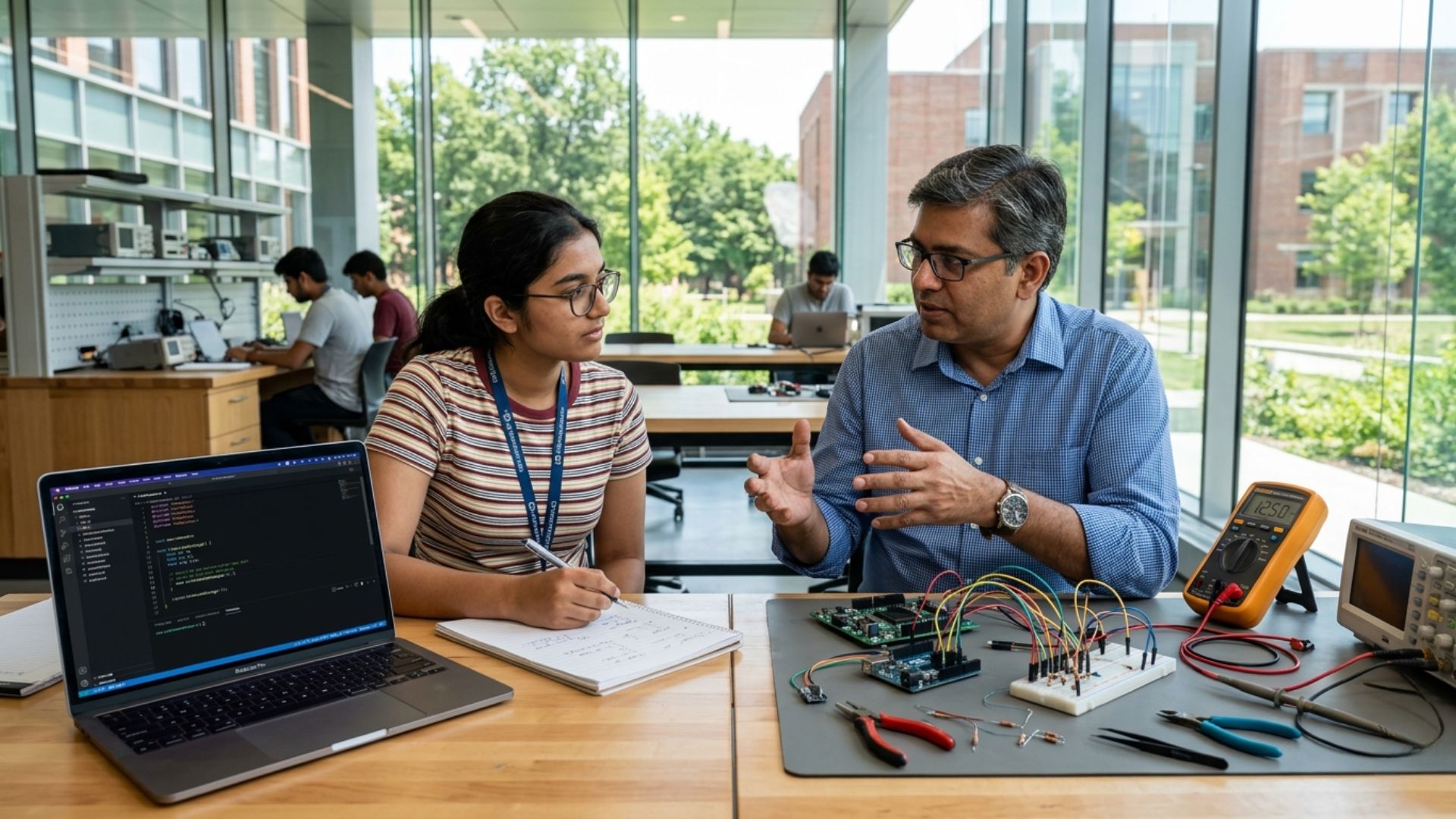
Choosing between Computer Science and Electrical Engineering can be confusing because both branches lead to strong technical careers. Computer Science is closely linked with software, AI, data, cloud and digital products. Electrical Engineering is connected with power systems, electronics, circuits, automation, EVs, semiconductors and hardware-led innovation.
The better branch is the one that matches how you think, learn and want to work in the future. Some students enjoy building software and solving logic-led problems, while others prefer working with circuits, devices, machines and physical systems.
CS vs Electrical Engineering: What Each Branch Focuses On
Computer Science Engineering: Computer Science focuses on software systems, data, algorithms and digital problem-solving. Students study programming, databases, operating systems, computer networks, cybersecurity, artificial intelligence, machine learning and cloud computing.
Globally, software careers continue to show strong demand, with the U.S. Bureau of Labor Statistics projecting 15% employment growth for software developers, quality assurance analysts and testers from 2024 to 2034. Students who want a deeper view of this path can also explore the future of computer science engineering .
Electrical Engineering: Electrical Engineering focuses on electricity, circuits, electronics, machines, control systems and power-based technologies. Students study subjects such as circuit theory, electrical machines, power systems, signals and systems, microprocessors, embedded systems and communication systems.
Electrical Engineering remains valuable because many future industries need strong hardware, electronics and infrastructure talent. BLS projects 7% employment growth for electrical and electronics engineers from 2024 to 2034.
This branch has future-facing relevance as India’s electronics, EV, semiconductor and renewable energy sectors continue to expand.
CS vs Electrical Engineering: Core Differences
The biggest difference between CS and Electrical Engineering is the type of system each branch focuses on.
Computer Science is mostly software-led. It deals with code, algorithms, applications, platforms, data and intelligent systems. It may suit students who enjoy coding, logical thinking, digital products and software problem solving
Electrical Engineering is more hardware and systems-led. It deals with circuits, power, electronics, machines, signals and physical devices. It may suit students who enjoy physics, electronics, hardware, energy systems and device-level problem solving.
There is also some overlap. Areas like robotics, IoT, embedded systems, automation and semiconductor design need both software and electrical knowledge.
Career Paths After CS and Electrical Engineering
Both CS and Electrical Engineering can lead to strong careers, but the type of roles and industries are different.
Computer Science may lead to roles in:
Software development
AI and Machine Learning
Data science and analytics
Cybersecurity
Cloud computing
Product engineering
Full-stack development
CS usually offers broader entry-level opportunities in software and technology-led roles because almost every industry now depends on digital systems, from finance and healthcare to e-commerce, logistics and education.
Electrical Engineering may lead to roles in:
Power systems
Electronics
Telecom
EV systems
Automation
Renewable energy
Embedded systems
Semiconductors
Electrical Engineering is more closely connected with core engineering and applied technology sectors. It remains valuable because future industries will need strong talent in hardware, electronics, infrastructure and energy systems.
Skills Required for CS and Electrical Engineering
CS students need strong programming, problem-solving, mathematics, system design thinking and project-building skills. They should also be comfortable learning new tools, languages and frameworks because software technologies change quickly.
Electrical Engineering students should have a good grasp of physics, mathematics, circuit understanding, analytical thinking and practical lab skills. They should be comfortable working with systems that connect theory with real-world hardware devices and infrastructure.
Both branches also require communication, teamwork, internships, projects and continuous learning. Beyond the degree, employers increasingly look for students who can apply concepts, build projects and solve practical problems.
For students having keen interest toward CS, institutions with industry-led learning models can make a difference. Scaler School of Technology , for example, focuses on core computer science fundamentals, with deep AI-integrated learning, 50+ real-world projects and industry exposure for students who want to build a strong career in tech & AI.
How to Decide Between CS and Electrical Engineering
Choose Computer Science if your goal is to work in software development, AI, machine learning, data science, cybersecurity, cloud computing or digital product engineering. It is a better fit if you enjoy coding, logic, applications and building software-led products.
Students who are strongly leaning toward CS and AI-led careers can explore CS & AI programme , which is built around Computer Science Engineering for the AI era, with a learn-by-building approach and AI embedded in the curriculum from the beginning.
Choose Electrical Engineering if your goal is to work with circuits, machines, power systems, electronics, EVs, automation, semiconductors or embedded hardware. It is a better fit if you enjoy physics, devices, electrical systems and hardware-based problem-solving.
If you like both fields, explore overlap areas such as embedded systems, IoT, robotics, VLSI, automation and smart devices.
Conclusion
The CS vs Electrical Engineering choice should depend on the kind of career a student wants to build. CS is a stronger fit for students interested in software, AI, data, cloud, cybersecurity and digital product roles. Electrical Engineering is better suited for students who want to work with circuits, power systems, electronics, EVs, semiconductors, automation or embedded hardware.
Both branches can lead to strong careers when students build practical skills, do real-world projects, gain internship exposure and keep learning continuously with changing industry needs.
FAQs
1. Which is better, CS or Electrical Engineering?
CS is better for students who want careers in software, AI, data, cloud or cybersecurity. Electrical Engineering is better for students interested in circuits, electronics, power systems, EVs, automation and semiconductors.
2. Is Electrical Engineering good for the future?
Yes, Electrical Engineering has future scope in renewable energy, EVs, electronics, automation, embedded systems and semiconductors. It is more specialised than CS, but it remains important for hardware and infrastructure-led industries.
3. Can Electrical Engineering students get software jobs?
Yes, Electrical Engineering students can move into software jobs if they build programming, data structures, projects and internship experience. Embedded systems, IoT, robotics and automation are natural crossover areas between Electrical Engineering and software.