Engineering admissions through B Tech entrance exams are diverse, and most colleges follow different entrance exam criteria. So, many students are confused about whether to only concentrate on one B Tech entrance exam like JEE Main, or also consider private university entrance exams, state-level counselling or entrance exams conducted by colleges or institutes.
As there is no single entrance exam for BTech in India that suits everyone, the student will have to consider the college, subject of specialisation, level of preparation, location of the college, college fees and other criteria.
Who Can Apply for an Entrance Exam for BTech After 12th?
The eligibility criteria for B Tech entrance exams are usually a Class 12 or equivalent qualification from any recognised board. The student should have studied Physics, Chemistry and Mathematics in Class 12, along with other subjects like a technical/vocational subject, as specified by the concerned entrance exam conducting body and college.
Appearing in Class 12 is also one of the key criteria to apply for many engineering entrance exams. Though candidates can apply for these exams while they are in Class 12, it is mandatory for them to fulfil the specified criteria at the time of admission. In some cases, colleges also specify the minimum percentage required in Class 12 for admission. Therefore, it is better to check the eligibility criteria specified by the college or exam conducting body before applying for the entrance exam for BTech after 12th.
B Tech Entrance Exams in India: Quick Comparison
Exam | Type | Best Suited For | Common Admission Route |
JEE Main | National-level | Students targeting NITs, IIITs, GFTIs and JEE Advanced eligibility | National engineering admission route |
JEE Advanced | National-level | Students aiming for IITs | IIT admission after qualifying JEE Main |
BITSAT | Private university | Students targeting BITS campuses | BITS admission route |
VITEEE | Private university | Students targeting VIT campuses | VIT BTech admission |
SRMJEEE | Private university | Students targeting SRM campuses | SRM BTech admission |
MET | Private university | Students targeting Manipal | Manipal admission route |
COMEDK UGET | State/private consortium | Students open to private colleges in Karnataka | Centralised counselling route |
MHT CET | State-level | Students targeting Maharashtra colleges | Maharashtra state counselling |
KCET | State-level | Students targeting Karnataka state colleges | Karnataka state counselling |
WBJEE | State-level | Students targeting West Bengal colleges | West Bengal state counselling |
AP EAPCET / TS EAMCET | State-level | Students targeting Andhra Pradesh or Telangana colleges | State counselling |
GUJCET / KEAM / OJEE | State-level | Students targeting Gujarat, Kerala or Odisha routes | State counselling |
This table gives a broad view of the major exams. Students should check the latest dates, eligibility, syllabus, exam pattern and counselling process from the official exam websites.
National-Level BTech Entrance Exams
National-level BTech entrance exams are useful for students looking for engineering admission options across India.
JEE Main
JEE Main is one of the leading and most common BTech entrance exams across India. A large number of engineering colleges and universities across the country use JEE Main scores for providing engineering seats to students. Students also have the option of appearing for JEE Advanced, provided they qualify through JEE Main, as JEE Main is the qualifying exam for JEE Advanced.
JEE Advanced
JEE Advanced is conducted for those students who qualify through JEE Main and are aspiring for engineering from the IITs. JEE Advanced is a more concept-heavy and competitive exam in comparison to many other engineering entrance exams. Students looking to join IITs will need to have strong command over Physics, Chemistry and Mathematics.
While the ranking in JEE Advanced is crucial for IIT admissions, there are several other factors at play, such as seat availability, branch preference and the counselling process. Hence, it is always better for students to keep options other than IITs open as well.
Private University and Institute-Specific BTech Exams
Many private universities in the country hold their own entrance tests for admissions to their BTech programmes through separate counselling processes.
Popular private university exams include:
BITSAT for BITS campuses
VITEEE for VIT campuses
NSET for Scaler School of Technology
SRMJEEE for SRM campuses
MET for Manipal
Other university-level engineering entrance tests
Students must compare BTech colleges offering the same course of study on the basis of courses or specialisations, campuses, fees, curriculum, internships, placement companies and counselling process.
For students looking for industry-aligned, learn-by-building Computer Science education, NSET is an entrance exam they can prepare for to apply to the CS & AI Programme at Scaler School of Technology. This learning approach has also been highlighted in a Times of India feature on Scaler School of Technology.
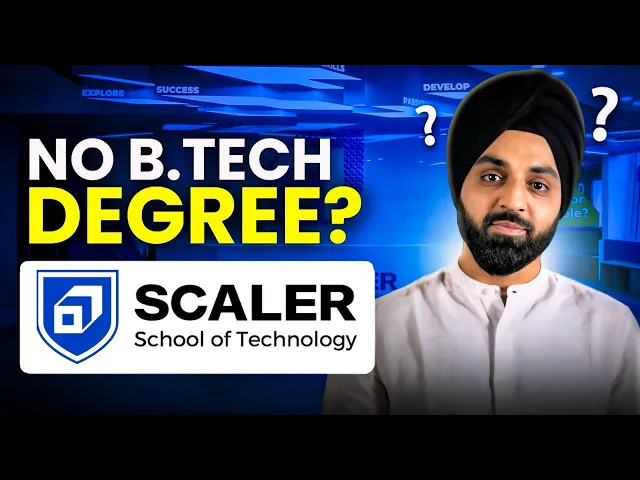
Students who want to understand this admission route and learning approach better can also watch this video.
Why SST does not provide a B.Tech Degree?
Students who are looking for the best private computer science options can refer to this guide on the best private colleges for CSE.
State-Level Entrance Exam for Btech after 12th
The state-level exams for BTech after 12th are conducted by various states for students to explore engineering colleges within the state, including regional government colleges, private colleges and the state counselling process.
MHT CET would be useful for students aiming to get into engineering colleges in Maharashtra. KCET would be useful for students who are eligible for state counselling in Karnataka. WBJEE would be useful for students who are aiming to get into engineering and technology colleges in West Bengal.
COMEDK UGET is an alternative entrance test for students who want to seek admission to engineering courses in private engineering colleges in Karnataka. It is different from KCET, which is conducted for state counselling. COMEDK UGET is used for the centralised counselling conducted by COMEDK for participating private engineering colleges in Karnataka.
AP EAPCET and TS EAMCET are useful for colleges in Andhra Pradesh and Telangana. GUJCET, KEAM and OJEE are useful for colleges in Gujarat, Kerala and Odisha respectively.
How to Decide Which BTech Exams Are Worth Applying For
Don’t apply for every possible exam. Instead, first decide which admission routes are relevant to your goals.
A student who wants to get into IITs needs to write JEE Main and JEE Advanced.
For NITs, IIITs and GFTIs, the main exam is JEE Main.
Students who are looking to get into private universities will have to write the entrance exams of the respective universities; for example, BITSAT for BITS campuses, VITEEE for VIT, SRMJEEE for SRM or MET for Manipal.
There are also state-level entrance exams for colleges in specific states.
Also, while choosing the various university exams, take into consideration the courses that the universities offer. While a university exam may be very popular, not all colleges available through that exam may have strong courses, coding culture, projects, internships and relevant placement support for the chosen branch.
A student interested in studying CSE, AI or Data Science with good industry exposure should not apply for an exam only because it is popular. Instead, they should find out the colleges where CSE, AI or Data Science courses are offered through that exam and then check whether the college has a strong curriculum, coding exposure, projects, internships and relevant placement roles.
A useful way to think is:
Student Priority | What to Check |
College Name | Which exam leads to that college? |
Preferred branch | Is the branch available through that exam and campus? |
Location | Is the student comfortable with that city or state? |
Fees | Is the total cost manageable for the family? |
Backup need | Does the exam give a real alternative if the JEE main result does not work out? |
Career goal | Does the college support the kind of roles the student wants later? |
Students who are not sure of their backup options after JEE Mains can check out this guide jee backup options.
Conclusion
There are several entrance exams for BTech after 12th in India. JEE Main, JEE Advanced, BITSAT, VITEEE, SRMJEEE, MET, COMEDK, MHT CET, NSET, KCET, WBJEE and several other state-level and university-level entrance exams.
The right B Tech entrance exam for a 12th passed student is determined by the colleges that the student wants to get into, the area of interest in terms of study, their level of preparation, the location of colleges, the student’s budget and the admission route. The student does not have to apply for all the entrance exams. They must apply for the entrance exams that lead to colleges and branches that they would actually like to consider.
FAQs
Which entrance exam for BTech after 12th is required?
In addition to JEE Main for admission to BTech after 12th class, many universities across India, including private universities, hold their own entrance exams. Students can also consider private university exams, state-level exams and institute-specific admission routes depending on their target colleges.
Can I get BTech admission without JEE Main?
Yes, BTech admission can be secured without the JEE Main exam. A student can search for colleges through private universities, state-level counselling processes and institute-specific admission processes.
How many B Tech entrance exams should a student apply for?
A student should apply for the entrance exams that match the colleges he/she wants to get into, the branch he/she wants to study, location comfort and backup plan. In reality, most students do not need to apply for all the exams. A focused list of 3-5 exams is usually enough if chosen carefully.