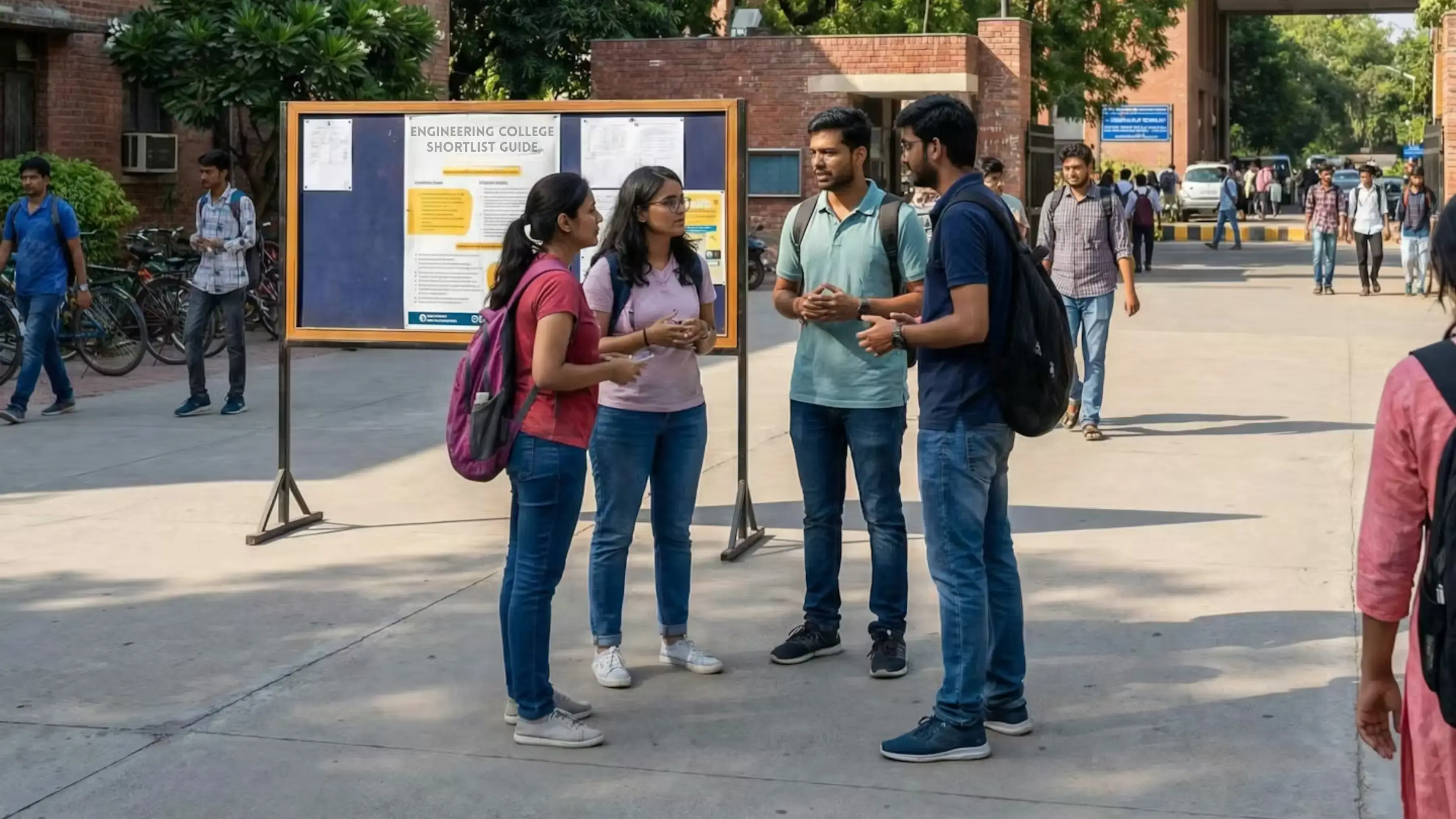
Students searching for the best engineering college apart from IIT should compare colleges on the basis of branch strength, curriculum quality, practical learning, internships, projects, placement opportunities, fees, and what the student can achieve with his/her degree in 4 years. A big name is important, but it is not everything. A student must choose a college that can help them achieve their goals through a good curriculum and practical exposure.
Why Students Should Look Beyond IIT
Many students are focused on IIT for engineering. The brand name of IIT, strong peer group, alumni network and good placements are attractions for parents and students alike. Unfortunately, the number of students seeking seats in IITs far exceeds the number of available seats.
However, looking beyond IIT is not about lowering your expectations from engineering education. It is a practical decision, and students who study in good non-IIT colleges, choose the right discipline, acquire the right skills, and build meaningful projects during their college can also create a strong career path for themselves.
Factors to Consider When Choosing the Best Engineering College Apart from IITs
A good engineering college is more than its popularity, ranking or a single placement figure. Students should check what a best engineering college apart from IITs offers for their specific branch of study and career goals.
Some important factors to compare include:
Branch strength
Curriculum quality
Faculty and mentor support
Practical projects
Labs and infrastructure
Internship opportunities
Placement relevance
Alumni outcomes
Peer group
Industry exposure
Fees and return on investment
Degree recognition and credibility
There are some colleges that may be better for Computer Science students and others for Mechanical, Electronics or core Engineering students. So while comparing two colleges, it is also important to compare them branch-wise.
Main Types of Engineering Colleges Beyond IIT
1. NITs
NITs are public technical institutions of high standards offering good education to students. NITs can be an alternative for students seeking a public college with a quality peer group, recognised degree and established placement support. As a rule, most NITs admit students on the basis of JEE Main scores.
2. IIITs
Most IIITs are predominantly CS, IT, AI, data and electronics-focused colleges for students. Although some have started to open up in other disciplines as well, a technology-focused approach is still evident in many campuses across the country. Hence, it is always wise to compare the campus, course curriculum, faculty, placements, and branch-wise performance of the college.
3. Strong Private Universities
There are also many private universities that can offer good value to students who are looking beyond IITs and NITs for engineering education. These universities can include names like BITS, VIT, Manipal University, SRM University, Amrita University and others. Such universities have their own entrance tests and course fees, which should be compared with other institutions offering similar value to arrive at the best decision.
4. State Government Engineering Colleges
All states in India have their own government engineering colleges. These can be good options for students as the fee structure in these colleges is often lower compared to private universities. Students can get into these colleges either by writing the state entrance exam through the counselling process. Also, one must check the branches offered, faculty members, labs, and placement records of the college.
5. New-Age Tech-Focused Colleges
There are a number of new colleges across the country that specialise in providing students with hands-on training. These institutions aim to develop students into industry-ready professionals and give them the right amount of knowledge and experience so that they can develop products, start their own ventures, or get internships and placements in software companies working on the latest technologies such as AI, data, and product engineering.
The Scaler School of Technology’s CS & AI Programme is a Computer Science programme with applied AI exposure. The programme focuses on a learn-by-building model where students build skills through real-world and industry-linked projects.
According to a June 2026 placement update published by ThePrint, 36% of students from the first batch of the programme had secured internships with pre-placement offer (PPO) opportunities before the formal placement season began. The companies offering these opportunities included Amazon, Rippling, Emergent and Slice. The average salary reported for students on the PPO track was ₹20 LPA, while the highest offer being ₹46 LPA.
Check Branch, Not Just College Name
A common error that students tend to make while choosing a college is to choose one only because of the brand name.
If a student is interested in studying fields related to Computer Science, such as Artificial Intelligence, Data Science, etc., then he or she must look into the college’s coding culture, the projects done by the students, the internships taken by the students, the software roles offered to students and the tech placements of the students.
If a student is interested in pursuing a degree in the field of Electronics and Communication, then he or she must look into the college’s labs, the degree of exposure that the student will get to study and work on embedded systems, semiconductor-related topics and the electronics placements of the students.
Students who are interested in pursuing core engineering degrees in fields such as Mechanical Engineering, Civil Engineering, Electrical Engineering, etc., must look into the quality of the college’s labs, the projects done by students in collaboration with industries, the core placements of the students and the amount of practical training that the student will receive.
A well-known college with an unsuitable engineering branch is not necessarily the best option to pursue higher education. A lesser-known college with the right engineering branch, good support for learning and relevant placements in related industries can be a better option for students.
This guide can also be used by students unsure about a college and a branch to structure comparisons of best colleges apart from IIT.
How to Check Placements Without Getting Misled
The highest package is not everything. In most colleges, the highest package is offered to only 1 or 2 students, so that cannot be the only parameter to check the placements of a college.
Students should check:
Median salary package
Average salary package
Placement percentage for each branch
Companies visiting the college
Available roles
Technical and non-technical profiles
Conversion from internship to job
Career paths of alumni
If you are a software engineering student looking for college placements, look for information on the kinds of roles that students from your branch are getting placed into, such as software, product, data, AI or cloud-related roles.
Good placement data should be transparent, branch-specific and role-specific.
Admission Routes for Best Engineering Colleges Apart from IIT
Common admission routes include:
JEE Main for NITs, IIITs and GFTIs
BITSAT for BITS campuses
VITEEE for VIT
MET for Manipal
SRMJEEE for SRM
State entrance exams such as MHT CET, KCET, WBJEE and others
University-level entrance tests
Students who want to know about other entrance exams apart from JEE Mains conducted for admissions to engineering colleges should read this guide here.
It is better to first make a list of colleges that one would like to get into and then start preparing for other entrance exams related to those colleges as and when they are due, instead of waiting for the results of a single entrance exam and then starting to look for colleges in a state of panic.
Students who are still exploring engineering options beyond IIT can also watch this video for more clarity.
मुझे IIT/NIT की अन्य शाखाओं की तुलना में SST CSE क्यों चुनना चाहिए?
How to Shortlist the Right Engineering College Beyond IIT
Fix the right engineering stream for yourself, like CSE, AI, Data Science, Electronics, Mechanical, Electrical, Civil, Robotics or any other branch of engineering that you might be interested in.
Make three lists of colleges - ambitious, realistic and backups.
Compare the colleges branch-wise. Do not compare only one college with another college. Compare the specific branch that you are planning to pursue with the same branch in another college. Find out how strong your specific branch is in that college.
Fees/ROI matters. In addition to the tuition fees for the college, students must also consider other costs like hostel fees, city expenses and travel costs. Students must compare these costs with the quality of learning, projects, labs, internships, placement support and overall career opportunities.
Last but not least is admission feasibility, which consists of entrance exams that students would need to write for admission, previous years’ cutoffs, application deadlines, the college’s counselling schedule and the student’s backup plan.
Common Mistakes Students Make While Choosing Colleges Beyond IIT
Students should avoid these mistakes while shortlisting colleges:
Treating non-IIT choices as failure
Making decisions only based on rankings
Deciding only based on the highest salary package
Not considering branch quality
Not considering costs or ROI
Missing entrance exam deadlines
Not making backup choices
Deciding without interacting with students or alumni
Assuming that CSE is better everywhere
Conclusion
There are many best engineering colleges apart from IIT that can offer good engineering education. NITs, IIITs, BITS, state engineering colleges, private universities and even emerging colleges that focus on technology.
The best engineering college outside of IITs is the one that best suits a student’s favourite subject or branch, budget, mode of learning and career goals. Thus, the college must have a strong base for study, practical learning, a good number of internships, placements in relevant industries and a good environment for growth.
FAQs
Which is the best engineering college apart from IIT?
Each student will have their own preferred college, and there is no single best option for everyone. Some options apart from IITs include NITs, IIITs, BITS, strong private engineering colleges, state government engineering colleges.
Are NITs good options apart from IIT?
Yes, many NITs are strong options apart from IITs, especially for students with good JEE Main scores. Students with good JEE Main scores can consider looking at these public engineering colleges with recognised names, strong peer groups and a good placement record.
Is missing IIT a big problem for engineering career growth?
Missing out on IITs is not the end of the road for an engineering student. It is very important for a student to get into the right stream, put in hard work, complete quality projects, get relevant internships and be ready to face placements. Alternatively, one could also look at higher education opportunities.